
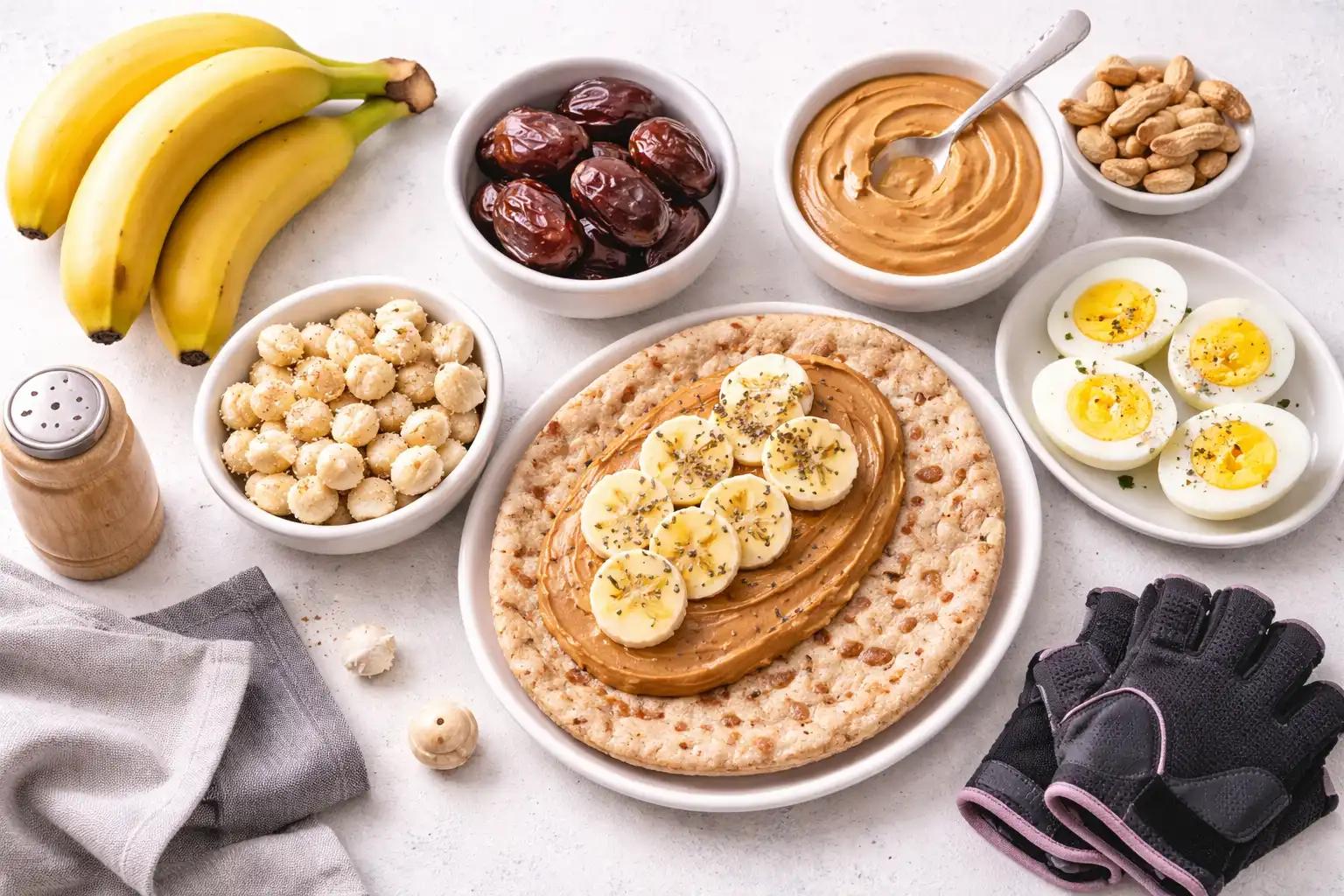
Starting a workout is one thing. Knowing what to eat before it can be much more confusing.
You may have heard that you need a special supplement, a protein shake, or a particular food before every gym session. In reality, your pre workout meal does not need to be complicated.
The right choice depends on several things: how long you have before exercising, the type of workout you are doing, your fitness goal, and how well your stomach handles food before exercise.
For most beginners, the basic idea is simple: choose foods that provide useful energy without making you feel overly full or uncomfortable during your workout.
Carbohydrates can provide fuel for exercise, while protein contributes amino acids needed for muscle maintenance and repair. The amount and timing of each can change depending on how close you are to your workout.
This guide explains how to choose a pre workout meal, when to eat it, what foods to choose, and what to avoid before training.
What Is a Pre Workout Meal?
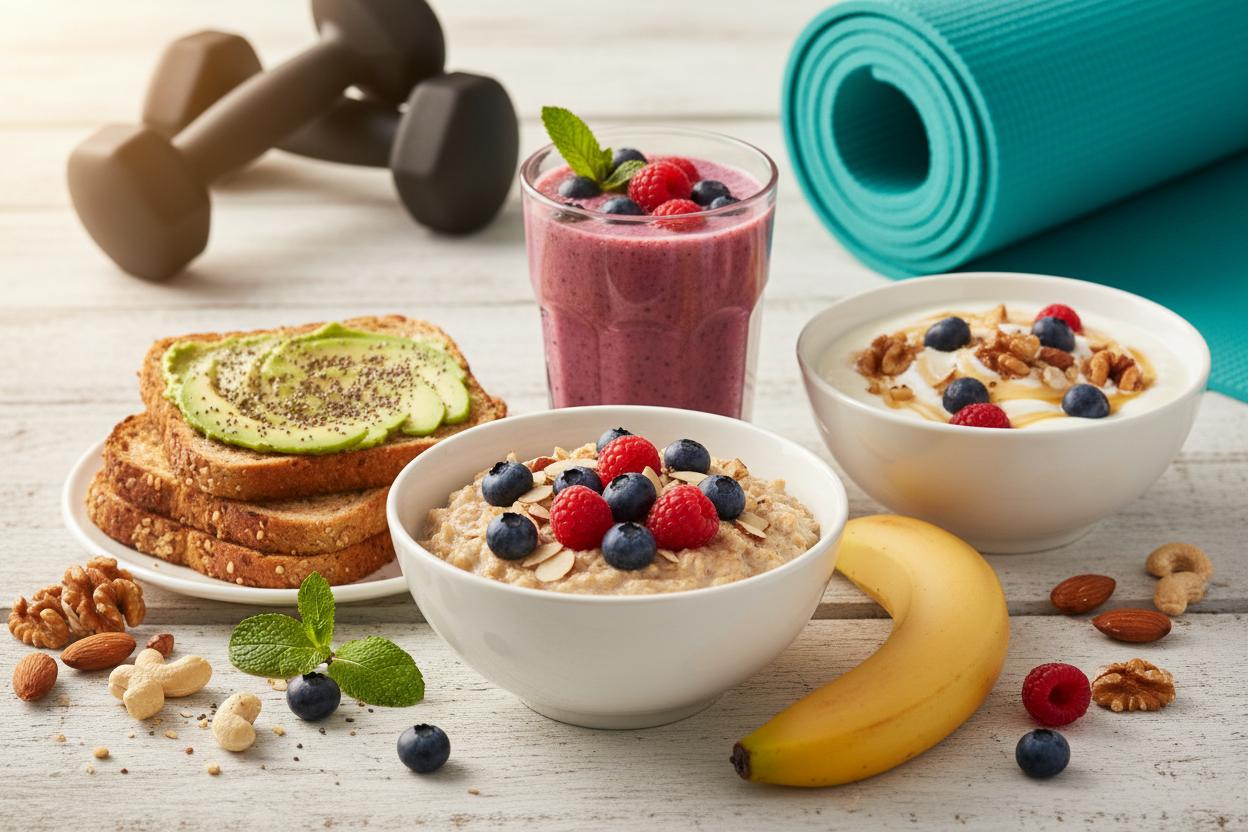
A pre workout meal is food eaten before exercise to provide your body with energy and nutrients that can support your training session.
It does not have to be a large meal. Depending on when you exercise, it could be a normal meal eaten a few hours beforehand or a small snack eaten shortly before training.
For example:
- Rice, dal, vegetables, and curd a few hours before training
- Oats with milk and fruit
- Eggs with whole grain toast
- Banana with yogurt
- A small fruit based snack shortly before exercise
The closer you get to your workout, the smaller and simpler your food generally needs to be because there is less time for digestion.
You also don’t necessarily need to eat before every workout. Some people prefer training without food, particularly for shorter or lower intensity sessions. What matters is whether eating beforehand helps you feel and perform better and whether it fits your overall nutrition.
How to Choose the Right Pre Workout Meal
There is no single best pre workout meal for everyone.
The right choice depends on four main factors.
1. How long before your workout are you eating?
A full meal can work well when you have several hours before exercise. If you only have 30 minutes, a lighter and easier to digest snack is usually more practical.
2. What type of workout are you doing?
A short, easy workout does not necessarily require the same amount of food as a long strength training session, running session, or high intensity workout.
3. What is your goal?
Someone trying to gain muscle may need more total calories and protein throughout the day. Someone trying to lose weight may need to control overall calorie intake.
However, your pre workout meal itself does not determine whether you gain or lose weight. Your overall diet and energy balance matter much more.
4. How does your body respond to food?
Some people can eat relatively close to exercise without problems. Others may experience bloating, cramps, reflux, or nausea.
Your own tolerance matters.
If a particular meal repeatedly makes you uncomfortable during workouts, it may not be the right pre workout food for you, even if it works well for someone else.
What Should a Pre Workout Meal Contain?
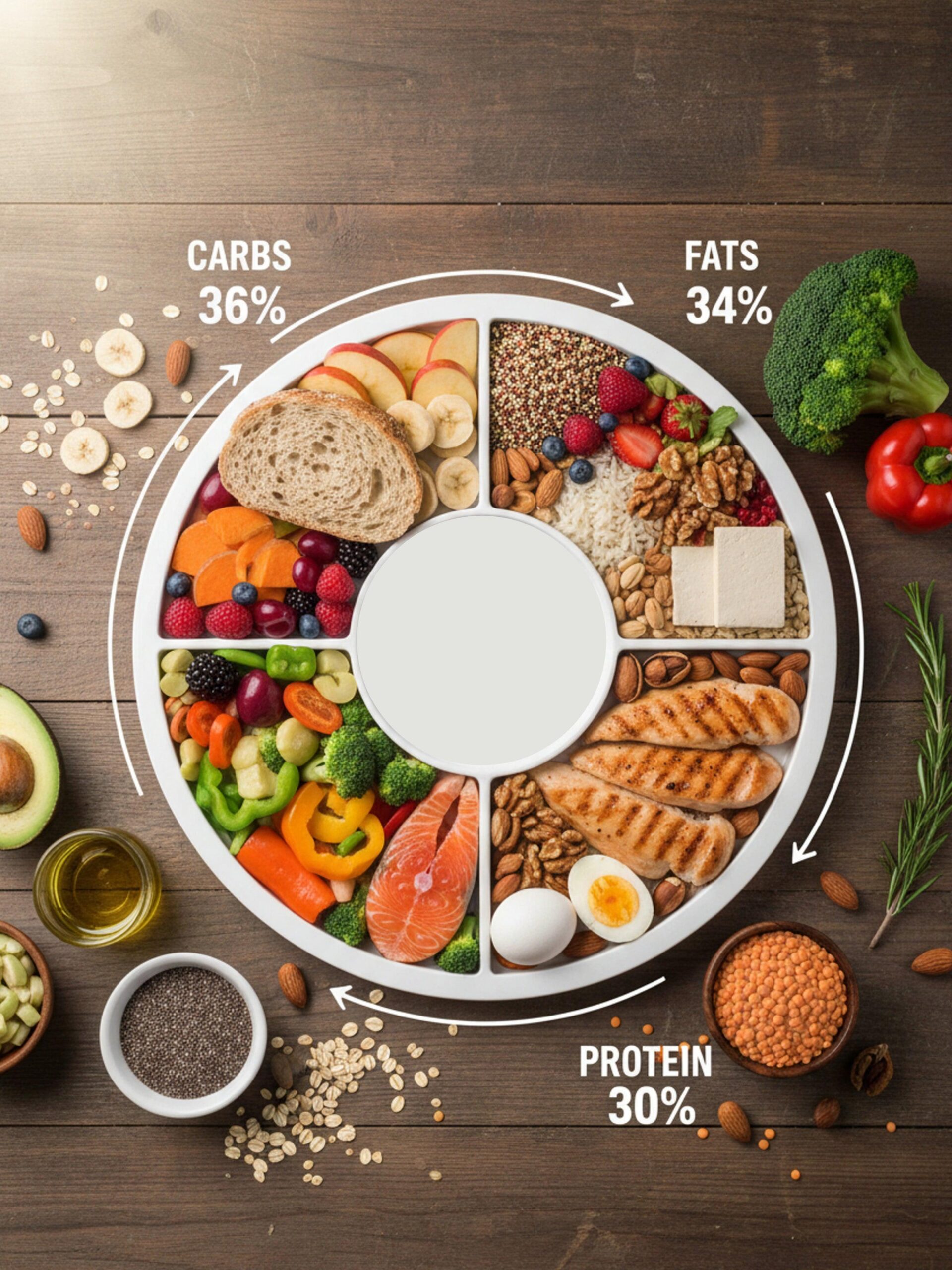
A useful pre workout meal generally focuses on carbohydrates and an appropriate amount of protein, while the amount of fat and fiber depends heavily on how close you are to exercising.
The closer your workout is, the more important it becomes to choose foods that are easy for you to digest.
A good pre workout meal should provide the nutrients your body needs for energy and exercise. The right balance usually includes carbohydrates and some protein, while the amount of fat and fiber can depend on how close you are to your workout. Understanding the different types of nutrients can help you make better choices about what to eat before exercising.
Carbohydrates
Carbohydrates are an important source of fuel during many forms of exercise, particularly moderate to high intensity activities.
Your body stores carbohydrate as glycogen in your muscles and liver. During exercise, these stores can contribute to your energy supply.
Good carbohydrate choices include:
- Oats
- Rice
- Potatoes
- Whole grain bread
- Roti
- Bananas
- Other fruits
- Poha
- Idli
- Other grain based foods
You don’t need to completely avoid carbohydrates before a workout because you’re trying to lose weight.
If weight loss is your goal, the bigger consideration is your overall calorie intake rather than eliminating carbohydrates from your pre workout meal.
Protein
Protein provides amino acids that your body uses to build and maintain tissues, including muscle.
Including some protein before training can be useful, particularly when you’re combining exercise with a muscle building goal.
Good options include:
- Eggs
- Milk
- Yogurt or curd
- Paneer
- Tofu
- Dal
- Chickpeas
- Beans
- Chicken
- Fish
You don’t need a protein shake simply because you’re going to the gym. Regular foods can provide protein too.
Your total daily protein intake is more important than trying to make one meal perfect.
carbohydrates and protein before exercise
Fat
Fat is an important nutrient, but large amounts of fat immediately before exercise may not be comfortable for everyone because fat takes longer to digest.
Foods such as nuts, seeds, avocado, and nut butters can be nutritious, but large portions may feel heavy when eaten shortly before training.
If you have two or three hours before exercise, a balanced meal can contain some fat.
If you only have 30 to 60 minutes, you may prefer a smaller meal with less fat.
Fluids and Hydration
Hydration is another important part of preparing for exercise.
You lose fluid through sweat during physical activity, and starting a workout already dehydrated can affect how you feel and perform.
Drink water regularly throughout the day rather than trying to drink a large amount immediately before exercise.
Your fluid needs can vary depending on:
- Workout duration
- Exercise intensity
- Temperature
- How much you sweat
- Individual needs
For longer or particularly sweaty training sessions, electrolytes may also become relevant.
When Should You Eat a Pre Workout Meal?
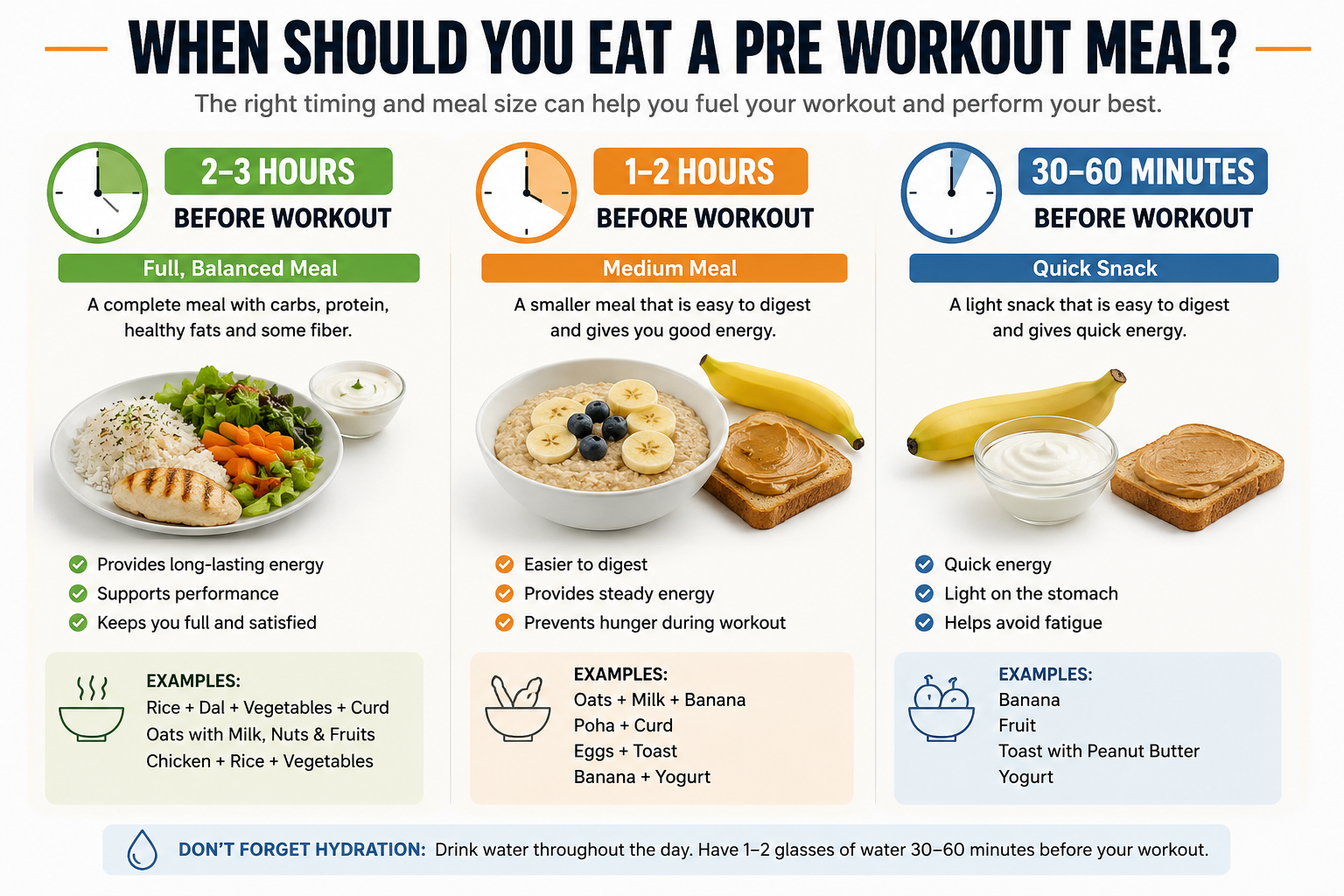
There is no universal “perfect” time to eat before exercising.
A practical approach is to adjust the size and composition of your meal according to how much time you have before training. Smaller and easier to digest foods are generally more practical as the workout gets closer.
2–3 Hours Before a Workout
This gives you enough time for a normal, balanced meal.
You can include:
- Carbohydrates
- Protein
- A moderate amount of fat
- Vegetables or fruit
Examples:
Rice + dal + vegetables + curd
Chicken + rice + vegetables
Paneer + roti + vegetables
Oats + milk + fruit + a small amount of nuts
Because you have more time to digest the meal, you generally have more flexibility with food choices.
1–2 Hours Before a Workout
When your workout is closer, reduce the size of your meal.
Focus more on easily tolerated carbohydrates with some protein.
Examples include:
- Banana + yogurt
- Oats + milk
- Toast + eggs
- Poha + curd
- Fruit + yogurt
- Small portion of rice + dal
Avoid making this meal excessively large.
The goal is to arrive at your workout feeling fueled rather than stuffed.
30–60 Minutes Before a Workout
At this point, you usually want something smaller and easier to digest.
Examples include:
- Banana
- Toast with a small amount of peanut butter
- Fruit
- Small yogurt
- Applesauce
- A small serving of oats
If you are sensitive to digestive discomfort, you may want to keep fat and fiber lower at this stage.
You also don’t need to force yourself to eat a large meal simply because you are going to exercise.
Pre Workout Meal Ideas
Your best pre workout food is ultimately the food that fits your timing, workout, goals, and digestion.
Here are practical options for different situations.
Pre Workout Meals for Beginners
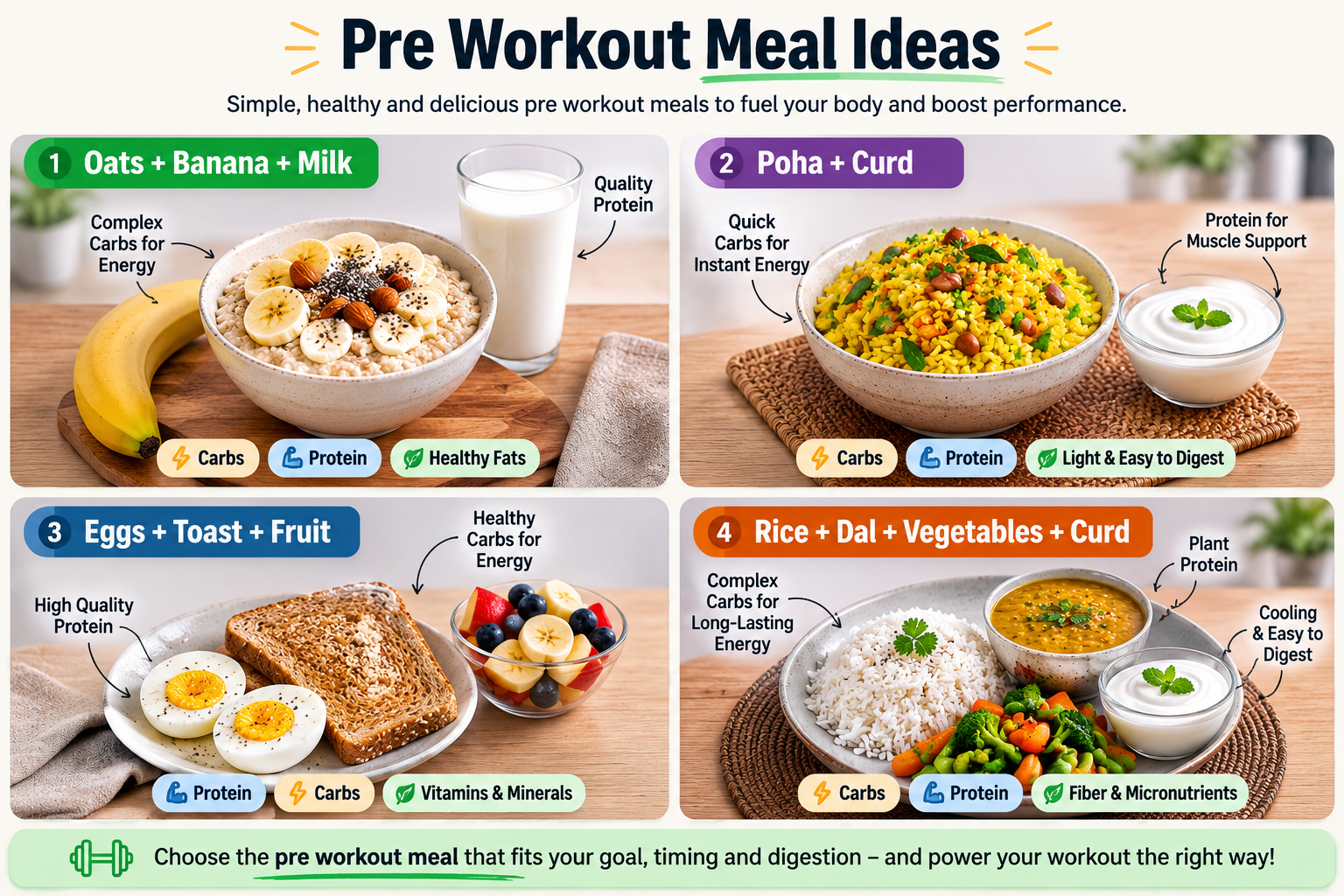
If you’re new to the gym, don’t overcomplicate your nutrition.
Start with familiar foods such as:
Option 1: Banana + yogurt
Option 2: Oats + milk + banana
Option 3: Poha + curd
Option 4: Two eggs + whole grain toast + fruit
Option 5: Idli + a moderate serving of sambar
Option 6: Rice + dal + vegetables if eating several hours before training
You don’t need expensive imported foods or a complicated supplement stack.
A simple meal you can digest comfortably and repeat consistently is often a better starting point.
Pre Workout Meals for Weight Loss
If you’re trying to lose weight, your pre workout meal should fit into your overall calorie target.
You don’t need to skip food before training just because you want to lose fat.
Good options can include:
- Banana + plain yogurt
- Two eggs + one slice of whole grain toast
- Oats + low fat milk + fruit
- Small serving of poha + curd
- Fruit + a small serving of yogurt
The key is portion size.
A calorie dense meal can still contribute a large number of calories even if all the individual foods are nutritious.
Your goal should be to eat enough to support your workout without turning the pre workout meal into an unnecessarily large part of your daily calorie intake.
Pre Workout Meals for Muscle Gain
If your goal is muscle gain, you generally need enough total calories and protein across the day.
A pre workout meal can contribute to those nutritional needs.
Examples include:
- Oats + milk + banana + yogurt
- Rice + dal + vegetables + curd
- Eggs + toast + fruit
- Paneer + roti + vegetables
- Chicken + rice + vegetables
- Tofu + rice + vegetables
You don’t need to eat an enormous meal immediately before training.
Instead, make sure your overall daily diet provides sufficient energy and protein.
Quick Pre Workout Snacks
Sometimes your schedule gives you very little time before the gym.
In that situation, keep things simple.
Try:
- Banana
- A piece of fruit
- Toast
- Small yogurt
- Applesauce
- A small bowl of oats
The closer you are to exercising, the more important it is to choose something your stomach handles well.
Benefits of Eating Before a Workout
Eating before exercise can be useful, but the benefits depend on the person and the workout.
A suitable meal may help you:
Support Energy
Carbohydrates provide an important source of fuel for many types of exercise.
Support Training Performance
Being appropriately fueled can make it easier to maintain your workout intensity, particularly during longer or harder sessions.
Reduce Excessive Hunger
If you arrive at the gym extremely hungry, concentrating on your workout can become difficult.
A suitable meal or snack may help you feel more comfortable.
Support Muscle Nutrition
Protein provides amino acids needed for muscle maintenance and repair.
Improve Workout Consistency
If eating a small meal before training helps you feel better and train consistently, it can become a useful part of your routine.
However, don’t treat your pre workout meal as a magic formula. Your overall diet, training program, recovery, and consistency have a much larger impact on long term results.
Practical Tips for Eating Before a Workout
If you’re a beginner, use these simple rules:
Don’t experiment on important workout days. Try new foods on easier training days first.
Give yourself enough digestion time. A large meal eaten immediately before exercise can cause discomfort.
Keep portions appropriate. More food does not automatically mean more energy during your workout.
Pay attention to your stomach. If a food causes bloating or cramps, choose another option.
Plan around your schedule. Your ideal meal is not useful if you regularly don’t have time to eat it.
Keep water available. Hydrate consistently rather than waiting until you’re extremely thirsty.
Don’t obsess over perfect macros. Beginners usually benefit more from establishing a consistent, balanced diet.
Remember your whole day nutrition. One meal cannot compensate for poor nutrition throughout the rest of the day.
Do You Need Pre Workout Supplements?
No. A supplement is not a requirement for having a productive workout.
Many people use products marketed as “pre workout” because they contain ingredients such as caffeine and other compounds intended to support alertness or exercise performance.
Caffeine can improve exercise performance for some people, but it is not necessary for everyone. It can also cause side effects such as nervousness, digestive discomfort, or sleep problems in some individuals.
Creatine is another supplement with substantial evidence for supporting certain types of exercise performance and muscle related adaptations, but it does not need to be taken immediately before a workout to work.
The important distinction is:
Pre workout supplement ≠ pre workout meal.
Food provides carbohydrates, protein, fats, fluids, vitamins, minerals, and other nutrients. A supplement is designed to provide specific compounds.
If you’re a beginner, focus first on:
- A balanced diet
- Adequate protein
- Appropriate calorie intake
- Hydration
- Consistent training
- Sufficient sleep
Supplements can be considered separately when there is a specific reason to use them.
What to Avoid Before a Workout
There isn’t a universal list of forbidden foods. What causes discomfort for one person may be completely fine for another.
However, certain choices can be problematic when consumed in large amounts or too close to exercise.
Very Large Meals
A huge meal immediately before training can leave you feeling heavy, bloated, or sluggish.
Excessively Fatty Foods
Large amounts of fried foods, heavy sauces, or other high fat foods may take longer to digest and can feel uncomfortable during exercise.
Very High Fiber Meals Close to Exercise
Fiber is an important part of a healthy diet, but a large amount immediately before intense exercise may cause digestive problems for some people.
Foods That You Know Upset Your Stomach
This is individual.
If milk, spicy foods, certain legumes, or another food consistently causes problems before exercise, don’t force yourself to eat it just because someone online calls it the best pre workout food.
Excessive Caffeine
Caffeine may improve performance for some people, but taking too much can cause jitters, rapid heartbeat, anxiety, or sleep problems.
Pre Workout Nutrition and Your Lifestyle
Your food before training is only one piece of your fitness routine.
Exercise
Your nutrition should match what you’re actually doing.
A person doing a short beginner workout does not necessarily need the same pre workout strategy as someone training for a long endurance event.
Start with a manageable workout routine and gradually increase the challenge.
If you’re new to exercise, focus on learning proper technique and building consistency rather than trying to train at maximum intensity every session.
Sleep
Sleep is an important part of recovery.
Even the best pre workout meal cannot compensate for consistently poor sleep.
Try to maintain a regular sleep schedule and give yourself enough time to rest.
Poor sleep can affect energy, concentration, exercise performance, and your ability to maintain healthy habits.
Stress and Recovery
Stress can affect your appetite, sleep, motivation, and recovery.
Your fitness routine should therefore include time for recovery rather than treating every day as a day to train harder.
Rest days, adequate sleep, balanced nutrition, hydration, and manageable training volume all contribute to recovery.
Frequently Asked Questions About Pre Workout Meals
What is the best pre workout meal?
There is no single best pre workout meal for everyone.
A good option generally provides carbohydrates and an appropriate amount of protein while being easy for you to digest.
Oats with milk and banana, rice with dal, eggs with toast, or yogurt with fruit can all work depending on your timing and preferences.
What should I eat 30 minutes before a workout?
Choose a small, easy to digest option if you are hungry.
A banana, fruit, toast, or a small serving of yogurt may work.
Avoid experimenting with large or heavy meals when you’re only 30 minutes away from exercise.
Is it better to eat before or after a workout?
Both pre and post workout nutrition can have a place in a balanced diet.
Eating before training may help provide fuel, while eating afterward can contribute to recovery and help you meet your daily nutrition needs.
The bigger priority is your total daily intake rather than trying to make one meal perfect.
Can I work out without eating first?
Yes. Some people can exercise comfortably without eating beforehand, particularly for shorter or lower intensity sessions.
However, others may feel weak, hungry, or lightheaded when training fasted.
If you consistently feel poorly during workouts without food, try a small snack beforehand and see whether it improves your experience.
What should I eat before a morning workout?
If you have enough time, you can eat something like oats with milk and fruit, eggs with toast, or yogurt with fruit.
If you’re exercising shortly after waking up and don’t tolerate a full meal, a small snack such as a banana may be easier to manage.
What should I eat before a workout for weight loss?
Choose a portion that fits your overall calorie needs.
A banana with yogurt, eggs with toast, or a small serving of oats can work.
You do not need to eliminate carbohydrates to lose weight. Overall calorie intake and dietary quality matter more.
What should I eat before a workout to build muscle?
Choose a meal containing carbohydrates and protein.
Examples include oats with milk and banana, rice with dal and curd, eggs with toast, paneer with roti, or chicken with rice.
For muscle gain, make sure your total daily calorie and protein intake supports your goal.
Is a banana good before a workout?
Yes. A banana is a convenient source of carbohydrate and is easy for many people to eat before exercise.
Whether it is enough on its own depends on your workout, hunger, and how long you have before training.
Do I need a pre workout supplement?
No.
You can have an effective workout without a pre workout supplement. Supplements such as caffeine or creatine may have specific uses, but they are not replacements for adequate food, hydration, sleep, and training.
Conclusion
A good pre workout meal does not need to be complicated or expensive.
Start with the basics: choose an appropriate source of carbohydrates, include some protein when suitable, stay hydrated, and adjust the amount of food according to how much time you have before exercise.
If you have two or three hours before training, you have more flexibility for a balanced meal. If you only have 30–60 minutes, choose something smaller and easier to digest.
Your goal also matters. Someone trying to lose weight may need smaller portions that fit their calorie needs, while someone trying to gain muscle may need more overall calories and protein throughout the day.
Most importantly, don’t spend so much time searching for the best pre workout meal that you forget the bigger picture. Your overall diet, training consistency, sleep, hydration, and recovery habits matter far more than one meal.
If you’re new to working out, start simple. Choose foods you already tolerate well, pay attention to how you feel during training, and adjust your pre workout food based on your own experience.
The best pre workout meal is not the most complicated one. It’s the one that gives you appropriate fuel, feels comfortable, fits your goals, and is easy enough to follow consistently.