
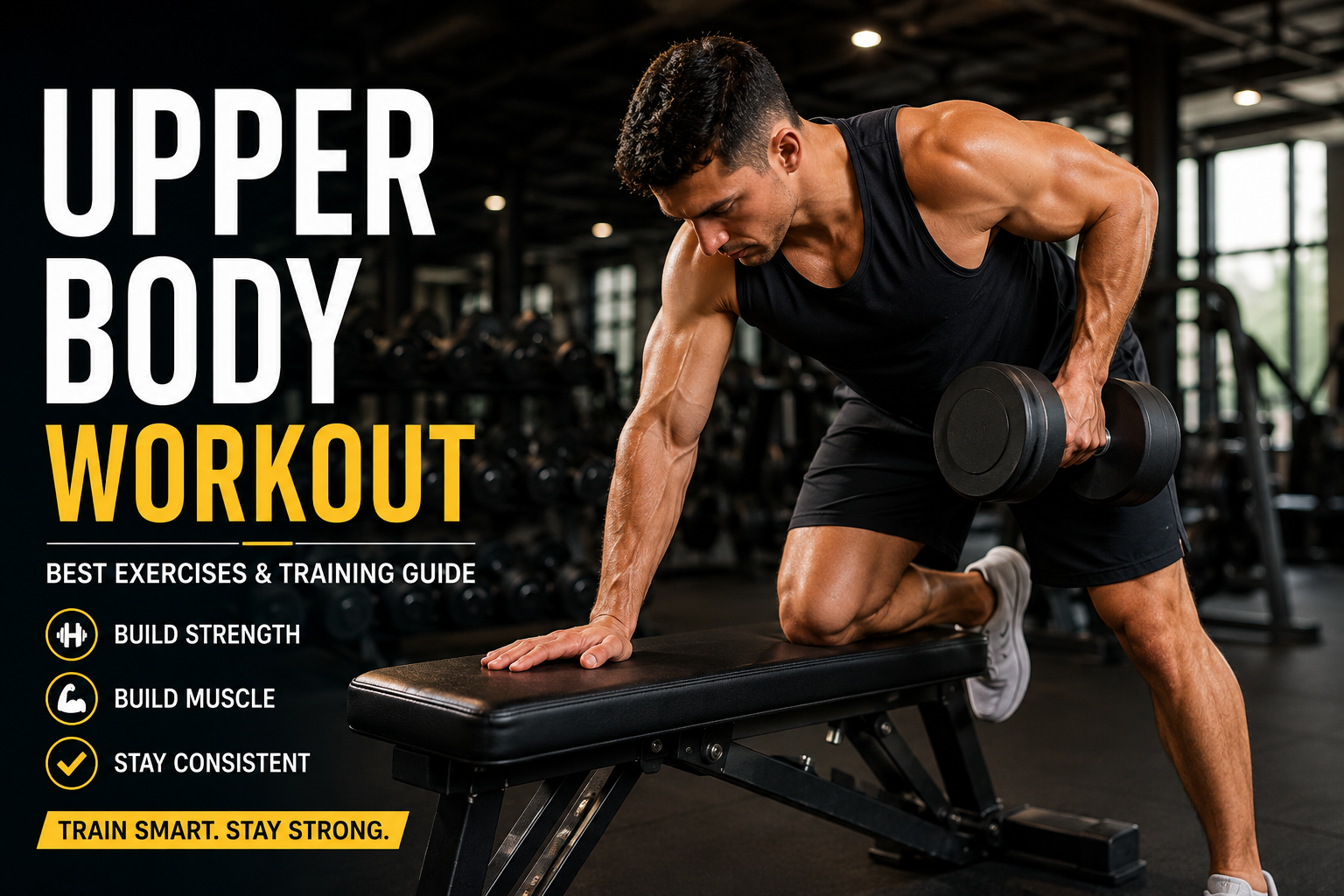
If you’re new to strength training, an upper body workout can seem complicated. There are dozens of machines, dumbbells, cables, and exercises to choose from, and it can be difficult to know which movements actually deserve your attention.
The good news is that you don’t need a long list of exercises to train your upper body effectively. A well-designed routine can cover your chest, back, shoulders, biceps, and triceps with a relatively small number of movements. Beginner-focused workout guidance also commonly emphasizes learning basic movements with manageable resistance and prioritizing proper technique before increasing weight.
For a beginner, the goal isn’t to lift as much weight as possible. It’s to learn how the exercises work, develop consistent training habits, and gradually become stronger.
This guide explains how to build an effective upper body workout, which exercises to focus on, how to organize them during the week, and how to progress as you become more comfortable with training.
What Makes an Effective Upper Body Workout?
An effective upper body workout doesn’t need to contain 15 different exercises.
The most useful routines cover the major upper body muscles and include both pushing and pulling movements. Compound exercises are particularly useful because they train several muscles at the same time, while isolation exercises can be added when you want to give a particular muscle more attention.
A balanced routine should generally include movements that train:
- Chest
- Back
- Shoulders
- Biceps
- Triceps
It should also match your experience level.
If you’re a beginner, start with exercises you can perform with controlled technique. You don’t need to train until complete exhaustion every session. Instead, use a resistance that challenges you while allowing you to maintain good form.
An effective routine should also be practical enough to repeat consistently. A simple workout you can follow for several months is more useful than a complicated routine you abandon after two weeks.
Understanding Your Upper Body Muscles
You don’t need to memorize detailed anatomy to start exercising, but understanding the major muscle groups can help you choose a balanced routine.
Chest
The chest muscles contribute to pushing movements. Exercises such as push-ups and bench presses train the chest while also involving the shoulders and triceps.
Back
Your back includes several muscles that help with pulling movements, shoulder movement, and maintaining control of your upper body.
Rows and lat pulldowns are useful examples of back-focused exercises.
Shoulders
The shoulder muscles help move and stabilize your arms.
Overhead presses primarily train the front and middle portions of the shoulders, while lateral raises place more emphasis on the side deltoids.
Biceps
The biceps are located at the front of the upper arm and help bend the elbow.
Biceps curls are a simple isolation exercise for training them directly.
Triceps
The triceps are located at the back of the upper arm and help straighten the elbow.
Pressing exercises already involve the triceps, but exercises such as triceps extensions can train them more directly.
A balanced upper body workout should not focus only on the muscles you can easily see in the mirror. Training your back and other supporting muscles is equally important for balanced development and strength.
How to Choose Upper Body Exercises
You don’t need to choose exercises simply because they’re popular.
Consider these factors instead.
Your fitness level
A beginner should start with movements that can be performed safely and consistently. If a standard push-up is too difficult, for example, an incline or wall push-up can provide an easier starting point.
Your available equipment
You can train your upper body using bodyweight exercises, dumbbells, resistance bands, machines, barbells, or a combination of these.
You don’t need access to every piece of gym equipment.
Your goal
Your exercise selection can change depending on whether your priority is general fitness, strength, or building muscle.
Your technique
An exercise isn’t useful if you cannot perform it with reasonable control.
Start with a manageable resistance and learn the movement before worrying about lifting heavier weights.
Your recovery
Your workout should fit into a schedule that gives your muscles enough time to recover. Beginners generally don’t need to train the same upper body muscles every day.
8 Best Upper Body Exercises
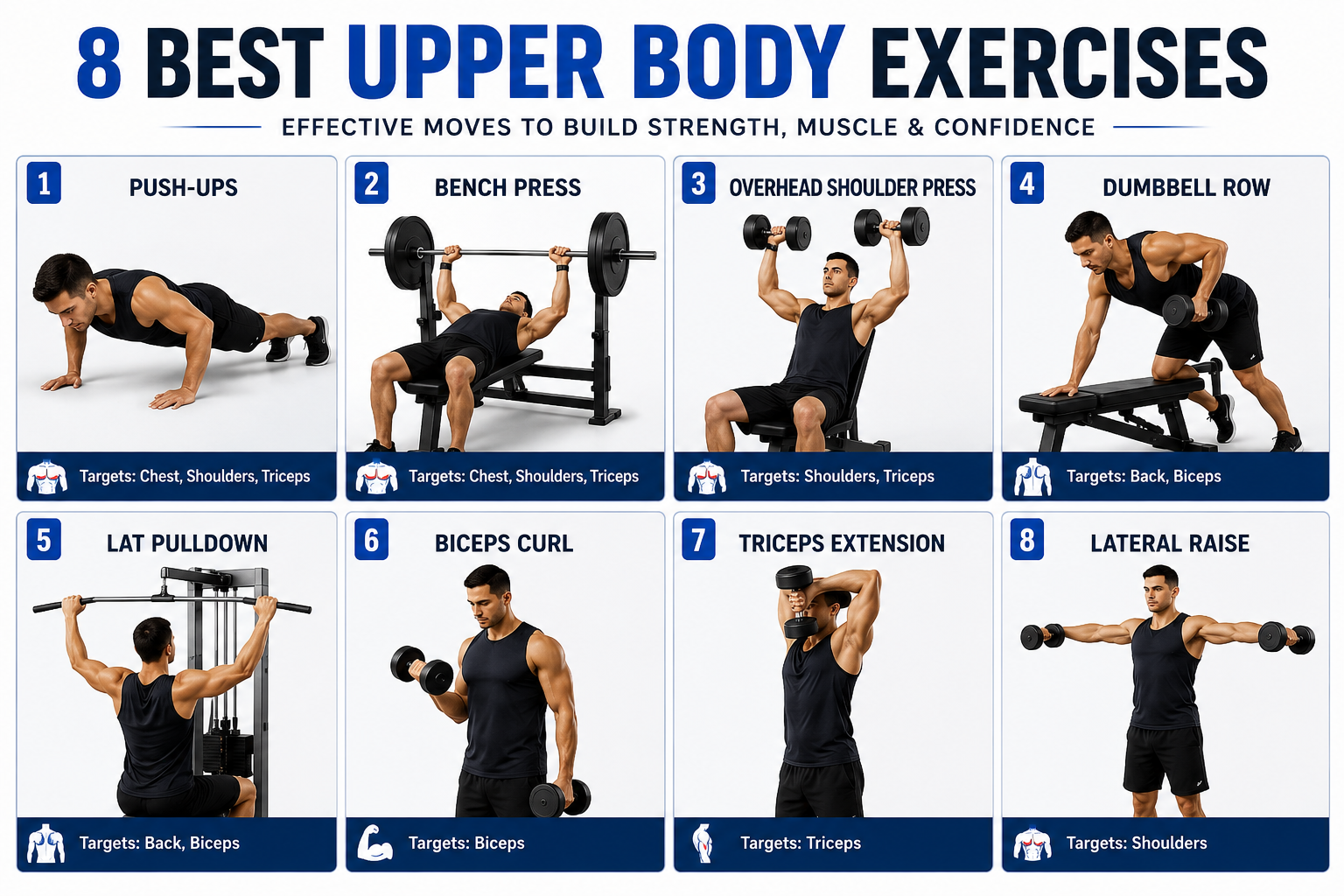
The following exercises cover the major upper body muscle groups and can form the foundation of a beginner-friendly routine.
Push-Ups
Push-ups are a bodyweight pressing exercise that primarily trains the chest while also involving the triceps and shoulders.
To perform a basic push-up:
- Place your hands slightly wider than shoulder width.
- Keep your body in a relatively straight line from head to heels.
- Brace your core.
- Bend your elbows and lower your chest toward the floor.
- Push through your hands to return to the starting position.
If a standard push-up is too difficult, start with a wall or incline push-up. As you become stronger, you can gradually work toward floor push-ups. Beginner fitness guidance commonly recommends modified versions when standard push-ups are too challenging.
Bench Press
The bench press is a popular strength exercise for the chest and also works the triceps and shoulders.
You can perform it with a barbell or dumbbells.
When starting, use a weight that allows you to control the movement. Keep your feet stable, avoid bouncing the weight off your chest, and don’t sacrifice your technique to lift heavier.
If you’re completely new to the movement, consider learning it with a qualified trainer or using a machine variation while you become comfortable with pressing mechanics.
Overhead Shoulder Press
The overhead press trains the shoulders while also involving the triceps and other muscles that help stabilize your body.
You can perform it with dumbbells, a barbell, or a machine.
For a basic dumbbell version:
- Hold the dumbbells around shoulder height.
- Brace your core.
- Press the weights upward.
- Avoid excessively arching your lower back.
- Lower the weights under control.
Start light. If you have to lean backward significantly to complete the repetition, the resistance may be too heavy.
Dumbbell Row
The dumbbell row is a pulling exercise that primarily trains the back while also involving the biceps.
To perform it:
- Hold a dumbbell in one hand.
- Support yourself with the opposite hand if needed.
- Keep your back controlled and your torso stable.
- Pull the dumbbell toward your hip.
- Lower it slowly.
Focus on moving your arm while keeping your body stable rather than using momentum to swing the weight.
Lat Pulldown
The lat pulldown trains the muscles of the back and also involves the biceps.
Sit at the machine, grip the bar, and pull it toward your upper chest while keeping your torso controlled. Return the bar slowly rather than allowing the weight to pull your arms upward suddenly.
Avoid turning the movement into a full-body swing.
The lat pulldown is particularly useful for beginners because the machine allows you to adjust the resistance and learn the pulling movement before progressing to more demanding exercises.
Biceps Curl
Biceps curls isolate the biceps by repeatedly bending and straightening the elbow under resistance.
To perform a basic dumbbell curl:
- Stand with your arms by your sides.
- Hold the dumbbells with your palms facing forward.
- Keep your elbows close to your torso.
- Curl the weights toward your shoulders.
- Lower them slowly.
Avoid swinging your entire body to move the weight.
Using a lighter weight with controlled repetitions is generally more useful than using a heavy weight that forces you to rely on momentum.
Triceps Extension
Triceps extensions directly train the muscles at the back of your upper arms.
You can perform them with a dumbbell, cable machine, or other suitable resistance.
For an overhead dumbbell extension:
- Hold one dumbbell with both hands.
- Position it above or slightly behind your head.
- Keep your elbows pointing generally forward.
- Lower the weight behind your head.
- Extend your elbows to return to the starting position.
Use a manageable weight and avoid forcing the movement if you experience pain.
Lateral Raise
Lateral raises target the side portion of the shoulders.
Hold light dumbbells at your sides and raise your arms outward until they approach shoulder height. Lower them slowly.
This is an exercise where using too much weight can quickly turn a controlled movement into a swinging motion.
Choose a resistance that allows you to control both the lifting and lowering phases.
How to Add Upper Body Exercises to Your Weekly Workout
You don’t necessarily need to dedicate every day to your upper body.
For beginners, training the upper body around two times per week can be a practical starting point, with recovery time between sessions. Beginner programs commonly recommend two or three sessions per week with rest between workouts, while research reviews have examined how training frequency affects strength gains.
Your exact schedule depends on how you structure your entire training week.
For example:
Monday: Upper body
Tuesday: Lower body or rest
Wednesday: Rest or light activity
Thursday: Upper body
Friday: Lower body or rest
Saturday: Optional activity
Sunday: Rest
You could also combine upper body training with full-body workouts instead of using an upper/lower split.
The important point is to avoid adding more training simply because you think more is always better.
Your muscles need time to recover and adapt.
If you’re new to exercise and want to understand how different training styles fit together, this beginner’s guide to all types of workouts can help you choose a routine that matches your goals.
How to Progress Your Upper Body Workouts
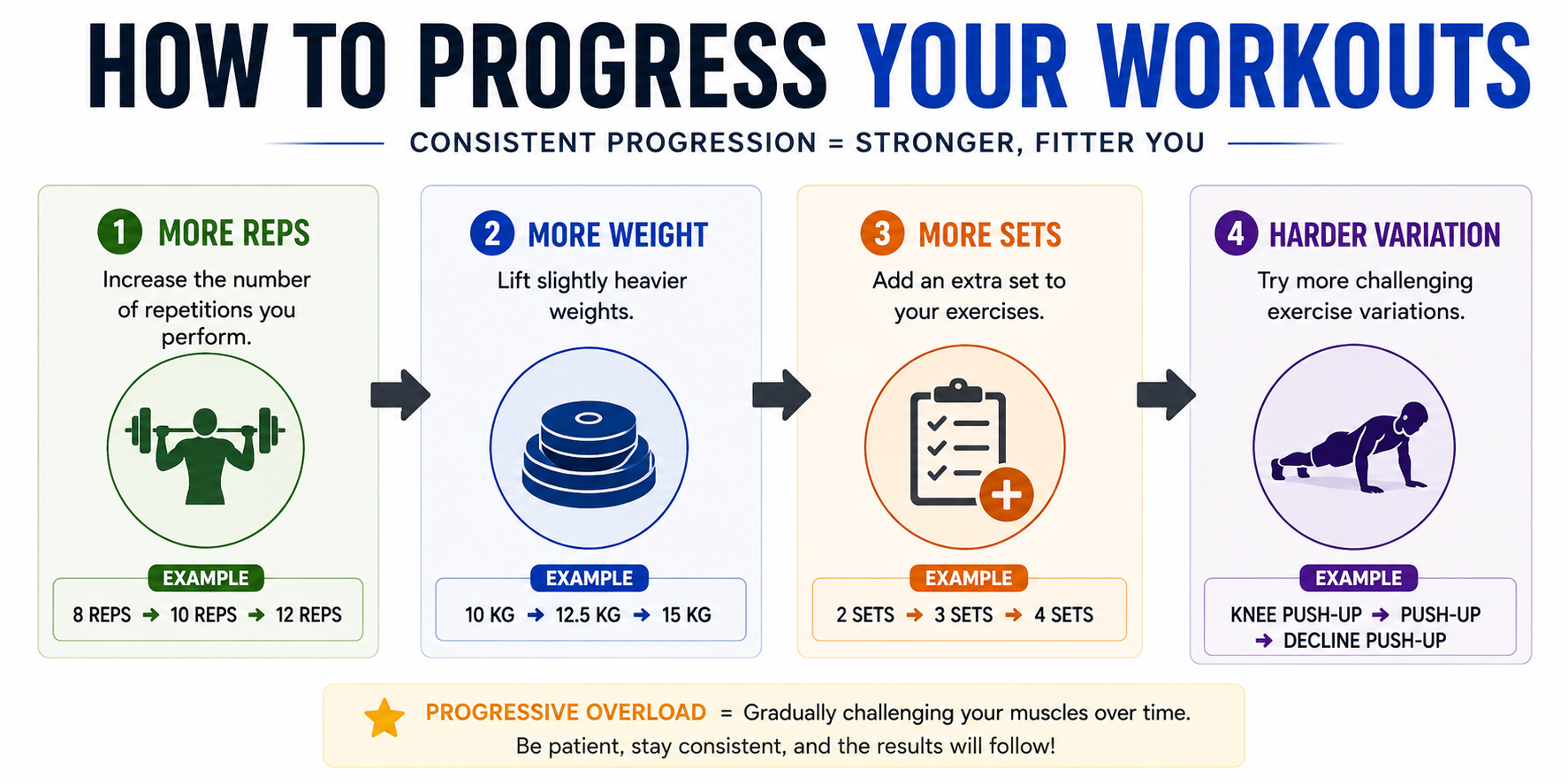
Doing the exact same workout with the exact same resistance forever will eventually make progress harder.
Instead, gradually increase the challenge.
This is often referred to as progressive overload.
You can progress by:
- Increasing the weight
- Performing more repetitions
- Adding a set
- Improving your technique
- Using a more challenging variation
- Increasing your range of motion when appropriate
- Reducing assistance as you become stronger
You don’t need to increase everything at once.
For example, if you can perform 8 controlled repetitions with a particular weight, you might eventually work toward 10 or 12 repetitions. Once the exercise becomes comfortably manageable, you can consider increasing the resistance.
Keep a simple record of your workouts so you know what you’re actually improving.
Beginner Upper Body Workout
If you’re completely new to strength training, you don’t need to perform all eight exercises in every session.
A simple beginner upper body workout can focus on the major movement patterns and include a small amount of direct arm work.
Beginner Routine
| Exercise | Sets | Repetitions |
| Push-ups or incline push-ups | 3 | 8–12 |
| Dumbbell row | 3 | 8–12 |
| Dumbbell shoulder press | 2–3 | 8–12 |
| Lat pulldown | 2–3 | 8–12 |
| Biceps curl | 2 | 10–15 |
| Triceps extension | 2 | 10–15 |
| Lateral raise | 2 | 10–15 |
You don’t have to use these exact numbers forever. They’re a starting point.
Choose a resistance that makes the final repetitions challenging while allowing you to maintain good technique.
Before your workout, spend a few minutes preparing your body. A general warm-up can include light movement and easier versions of the exercises you’re about to perform. Beginner workout guidance also commonly recommends warming up and starting with lighter resistance while learning technique.
You can rest between sets according to the difficulty of the exercise and your experience. Give yourself enough time to perform the next set with reasonable control rather than rushing simply to finish the workout.
If you’re completely new to strength training, consider getting instruction from a qualified fitness professional, particularly for exercises such as the bench press.
Training is only one part of making progress. Your body also needs adequate nutrition and recovery to support your workouts. Understanding the different types of nutrients can help you make better choices about what you eat.
Need help with exercise form? Watch a demonstration of the movement before adding weight to your workout.https://www.youtube.com/watch?v=_JPsAGc3M7U
Benefits of Upper Body Workouts
A consistent upper body workout can provide benefits beyond appearance.
Builds Strength
Regular resistance training can help you become stronger and make everyday physical tasks easier.
Supports Muscle Development
Progressive resistance training can stimulate muscle growth when combined with appropriate nutrition and recovery.
Improves Physical Function
Upper body strength contributes to movements such as pushing, pulling, lifting, carrying, and reaching.
Supports Balanced Training
Training the chest, back, shoulders, and arms gives you a more balanced approach than focusing only on one muscle group.
Can Improve Confidence in the Gym
Learning how to perform basic exercises can make the gym feel less intimidating.
Supports Overall Fitness
Strength training is one component of a well-rounded fitness routine. It can complement aerobic activity, mobility work, and other forms of exercise.
Common Upper Body Workout Mistakes to Avoid
Using Too Much Weight
Heavy weights aren’t automatically better.
If you cannot control the exercise, reduce the resistance and focus on your technique.
Ignoring Your Back
Many beginners focus heavily on the chest, shoulders, and arms because these muscles are easy to see.
Don’t neglect pulling exercises such as rows and lat pulldowns.
Doing Too Many Exercises
More exercises don’t automatically produce better results.
A small number of well-chosen movements can provide enough training stimulus, especially when you’re a beginner.
Training Without Progression
If you never increase the challenge, your workouts may eventually stop providing enough stimulus to continue progressing.
Track your workouts and make gradual changes when appropriate.
Sacrificing Form for Repetitions
Don’t rush through repetitions simply to reach a target number.
Controlled movement and appropriate resistance should take priority.
Skipping Recovery
Training harder doesn’t mean training every day.
Give your muscles time to recover, especially when you’re new to resistance training.
Copying an Advanced Workout
A routine designed for an experienced lifter isn’t necessarily appropriate for a beginner.
Start with a manageable amount of training and build gradually.
Ignoring Pain
Muscle fatigue and effort are normal during exercise, but sharp or unusual pain shouldn’t simply be pushed through.
Stop the exercise if something feels wrong and seek appropriate professional guidance when necessary.
Frequently Asked Questions About Upper Body Workouts
What is an upper body workout?
An upper body workout is a training session focused on muscles such as the chest, back, shoulders, biceps, and triceps.
It can include bodyweight exercises, free weights, resistance bands, machines, or a combination of these.
How often should beginners do an upper body workout?
For many beginners, around two upper body sessions per week can be a practical starting point, with recovery time between sessions. The right frequency depends on your overall training schedule, fitness level, and recovery. Beginner programs commonly use two or three sessions per week rather than training the same muscles every day.
Can I build upper body strength without a gym?
Yes.
Push-ups, resistance bands, and dumbbells can provide effective training without access to a traditional gym.
The exercises may need to become progressively more challenging as you become stronger.
How many exercises should an upper body workout include?
You don’t need a fixed number.
For beginners, around five to seven well-chosen exercises can be enough to cover the major muscle groups. You can adjust the number based on your training experience, available time, and goals.
Should I train chest and back on the same day?
Yes.
Training chest and back in the same session can work well because you’re covering both pushing and pulling movements.
The important thing is to manage your overall training volume and recovery.
Can I do an upper body workout every day?
Doing a hard upper body workout every day is generally unnecessary for beginners.
Your muscles need recovery between challenging sessions. You can remain active on other days by training your lower body, doing appropriate aerobic activity, or using lighter activities.
How long should an upper body workout take?
There is no required duration.
A focused beginner workout may take around 30–60 minutes depending on the number of exercises, sets, rest periods, and your experience.
The goal should be effective training rather than staying in the gym for a specific number of minutes.
What should beginners do if they can’t do push-ups?
Start with an easier variation.
Wall push-ups and incline push-ups reduce the amount of body weight you need to move. As your strength improves, you can gradually progress toward standard floor push-ups.
How long does it take to see results from upper body workouts?
There is no single timeline.
Your results depend on factors such as your starting fitness level, training consistency, nutrition, recovery, genetics, and the type of program you’re following.
Instead of judging progress only by appearance, track improvements in strength, repetitions, technique, and consistency.
Conclusion
A good upper body workout doesn’t need to be complicated.
Start by learning the basic movement patterns and training the major upper body muscles: your chest, back, shoulders, biceps, and triceps. Exercises such as push-ups, bench presses, rows, lat pulldowns, shoulder presses, curls, triceps extensions, and lateral raises can give you a strong foundation.
If you’re a beginner, focus on technique before chasing heavier weights. Start with a manageable routine, train consistently, allow enough recovery, and gradually increase the challenge as you become stronger.
You also don’t need to perform every exercise in every workout. Choose a practical combination, track your progress, and adjust your routine over time.
The best upper body workout is ultimately one that is balanced, appropriate for your current fitness level, and realistic enough for you to follow consistently.